I keep returning to the idea of having some kind of alternative way to rate music beyond “I like or dislike it.” My first instinct is to call that an “objective” rating, even knowing that such a thing is impossible when applied to any kind of art, including music. But I’m realizing that objectivity isn’t really the goal here.
What I’m really after when I seek an “objective” rating is a way to identify good music that is disconnected from my personal taste. This rating could be useful for many reasons - it could provide the basis for recommending the music to other people, it can force me to listen to new things or things I dislike with more open ears, and it can help me appreciate the importance of music that is beyond the songs themselves.
My last attempt at a secondary rating system was aimed at this exact thing. I tried to identify 3 traits of music that I can more or less rate even if I didn’t like the music - Talent, Songwriting, and Importance. I also included a personal adjustment that was intended to balance out any distaste I might feel for the music - meaning I typically raised this when I disliked the album to avoid artificially lowering the rating due to my personal taste.
I like the idea of a simplistic system like the one I proposed. Simple systems stick, while more complex systems take an exponentially higher amount of energy to maintain and put into practice. But I haven’t found this approach very helpful, and I don’t think it really separated my personal taste from the rating. See the graph below - this is a plot of my personal "Taste” rating vs. my attempted “objective” rating per song.
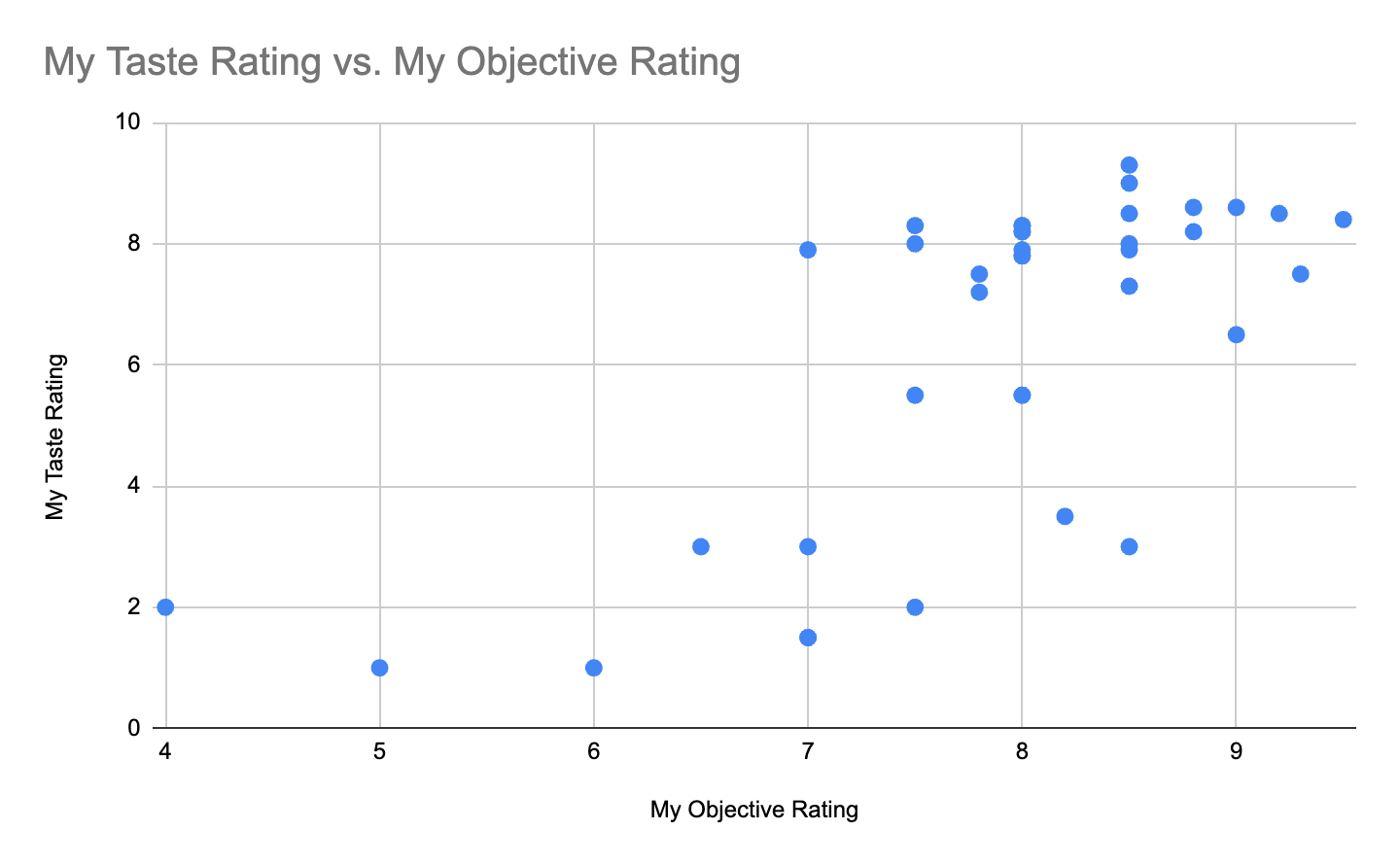
I see a pretty strong trend here. The higher my taste rating is, the higher my so-called objective rating is. This means one thing to me - my objective rating is just another way of saying if I like the music or not. There are very few albums I don’t personally like that I have rated highly from an objective perspective. This means that there’s very little that’s objective about my alternative rating system.
So what to do? Well, I’m an engineer, and engineers are always happiest when stuff breaks. We tested my system to failure, it failed, and now we get to try something new.
First, let’s re-hash the purpose of this secondary rating - to create a second metric for music that separates my personal taste.
To that end, I’m calling the new system by a new name. Objectivity is kind of pointless in music, anyway. So I’m going to call my new rating my “brain” rating. So every album will have a Taste rating and a Brain rating.
What’s that mean? It means I’m going to create two subjective ratings about each album, one driven by how much I like the music (and want to listen to it again), and the other by the other things I learn about the music. It’ll be kind of like recommending a restaurant to someone who likes Italian food if I don’t like Italian food: If I know the chef is great, the ingredients are fresh, and the drinks are delicious, I can stand behind that recommendation.
(I love Italian food, along with almost every other kind of food there is, but you get the point)
This Brain Ranking will include many things (some of which might look familiar):
The importance of the album culturally, musically, or otherwise
The exceptional talent of the artist - singing, instrumentation, songwriting, etc.
Originality
Critical reception or acclaim
Commercial popularity
Now I want to be very careful with some of these. The last 2 points are especially tricky - I don’t want to become a mouthpiece for critics or for the Top-40 algorithms, each of which have their own problems creating truly good recommendations. But I can’t ignore that success in these two arenas is very important.
And the key difference between this rating and my previous rating is that I will be 100% making subjective ratings in these categories, and that’s OK. Because the goal isn’t to define once and for all “what is good music?” The goal is to create a rating I can stand behind when recommending the music to someone I think might like it, even if I don’t.